
News
Junior Fellow advances cybercrime research with INTERPOL and the University of Oxford
Cynthia Tan spent nine weeks at Oxford mapping how law enforcement agencies collaborate on cybercrime, and found cryptocurrency in nearly three-quarters of U.S. financial cybercrime indictments since 2020.
Junior Fellow Cynthia Tan travelled to the United Kingdom this summer as a Visiting Scholar at Oxford's Department of Sociology. Over nine weeks she built a social network analysis mapping how law enforcement agencies collaborate on cybercrime cases, drawing on U.S. Department of Justice financial cybercrime indictments to trace the roles of national and international bodies and the use of cryptocurrency as an anonymising tool. The project sets out both where cooperation is strong and where gaps persist in international law between agencies.
Much of the groundwork came from her earlier role as a research assistant on the institute's Bitcoin and Financial Freedom study, which examined how offenders exploit cryptocurrency in financial schemes. At Oxford she extended that work, and found that roughly one third of U.S. Department of Justice financial cybercrime indictments from 2020 to 2025 involved Bitcoin specifically, with nearly three quarters involving cryptocurrency more broadly. She plans to continue examining the structural role of cryptocurrency in transnational cybercrime and what it implies for comparative approaches to international law and cooperation.
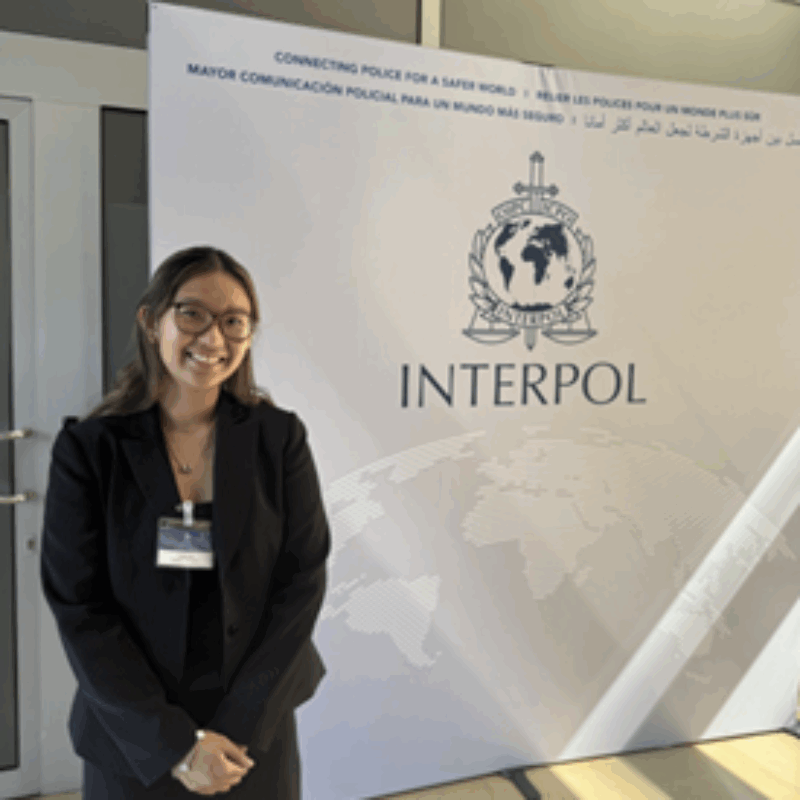
Over the same period she joined INTERPOL's Academic Cyber Offender Prevention Network and attended the Fifth InterCOP Conference at INTERPOL headquarters in Lyon, meeting global law enforcement leaders and researchers working on cybercrime prevention.
Tan has approached prevention from another angle as well. As a Laidlaw Scholar she worked with an FBI Special Agent studying how to deter youth involvement in cybercrime, a project that underlined the value of early intervention. Together these experiences gave her the technical and policy lens that shaped the Oxford research.
Her work at Oxford was supported by the Department of Sociology, whose guidance helped refine the scope of the project, and by the Frederic Conger Wood Fellowship, awarded by the Institute for European Studies, part of the Einaudi Center for International Studies.